Bethel Sketty Cemetery
Preserving the History and Legacy of Bethel Sketty Cemetery


Bethel's Birds
Please note all birds listed here are protected under the The Wildlife and Countryside Act 1981

Carrion Crow
The carrion crow is all-black, with a glossy sheen. It has a black bill with no bare patches. Crows are usually found singly or in small numbers. They will eat dead animals, invertebrates and grain, as well as taking eggs and chicks.
Seen locally and in the Cemetery.


Blue Tit
The blue tit has a blue cap, white cheeks, black eye stripes, a greeny-blue back, yellow belly, and blue wings and tail. The blue tit is a bird of woodland. It nests in holes in trees. It feeds on insects and spiders among the smaller branches and leaves of trees in woodlands.
Seen locally and in the Cemetery.

Magpie
The magpie is a long-tailed bird. It is black, with a white belly and white patches on the shoulders and wings. Magpies are small crows. They feed on carrion, invertebrates, and chicks and eggs. Their habitats are gardens to parks, and heaths to hedges.
Seen locally and in the Cemetery.

House Sparrow
Male house sparrows are streaky brown above and grey below. They have chestnut wings with white wing bars, a black bib and a grey cap. Females and juveniles are a drab brown. They feed on buds, grains, nuts and scraps.
Classified in the UK as Red under the Birds of Conservation Concern
Seen locally and in the Cemetery.

Tree Sparrow
Smaller than the House Sparrow, they have brown upperparts and buff undersides. They have a chestnut-brown crown, white cheeks, a white collar and black cheek spots. They mainly feed on seeds, but will eat insects.
Classified in the UK as Red under the Birds of Conservation Concern
Seen locally and in the Cemetery.

Sparrow Hawk
Sparrowhawks are small birds of prey. They hunt birds in confined spaces, woodland, and gardens. Male sparrowhawks have bluish-grey back and wings and orangey-brown bars on their chest and belly. They hunt for small birds.
Classified in the UK as Amber under the Birds of Conservation Concern
Seen locally and in the Cemetery.

Great Tit
The great tit has a black head, white cheeks, green back, yellow belly and black stripe down its breast. They will eat insects and spiders.
Locally and in the Cemetery.

Black Bird
Blackbirds are entirely black in colour. Females, however, are actually dark brown, with lighter brown streaks on the breast. They eat earthworms, insects, caterpillars, fallen fruit and berries, foraging on the ground.
Seen locally and in the Cemetery.

Collared Dove
The collared dove is buff-coloured with darker grey wingtips, a black half-collar, and paler patches at the shoulders and at the end of the tail. Feeds on seeds and grain on the ground.
Seen locally and in the Cemetery.

Jackdaw
The jackdaw is our smallest crow. It's short, has a chunky bill, a grey 'shawl' around the back of the head, with a black cap and a white eye.
It eats invertebrates, fruit, seeds and carrion and occasionally takes eggs and nestlings. It nests in holes in trees, buildings and sometimes it will nest in chimneys.
Seen locally and in the Cemetery.
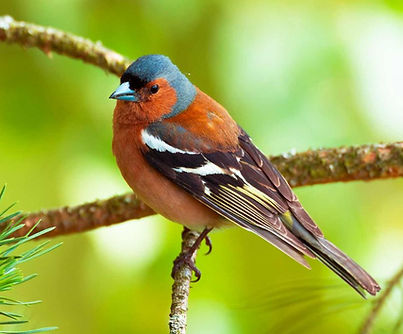
Chaffinch
It's the male chaffinch which is the colourful one, with a blue-grey crown, brown back and pink breast. The female being brown like a house sparrow. They feed on seeds and insects and build a bowl-shaped nests in trees and shrubs.
Seen locally and in the Cemetery.

Wood Pigeon
The woodpigeon is recognised by its pink breast, white neck patch and the white patches visible on its wings during flight. It feeds on seeds, leaves, grains, fruit, peas and root crops. They make a messy nest out of twigs in trees.
Classified in the UK as Amber under the Birds of Conservation Concern
Seen locally and in the Cemetery.